

New Year’s Communications Resolution: Plan the Work; Work the Plan.


Download Our 2026 Benefits Editorial Calendar to Help Move from Reactive to Proactive
As we begin a new year, many HR teams are coming off one of the most intense periods on their calendar: annual enrollment. The deadlines have passed, the emails have slowed, and the day-to-day rhythm of supporting employees has returned. It’s also the moment when many HR leaders pause and reflect.
They know—at least in theory—that year-round benefits communication leads to better understanding, higher utilization, and a stronger employee experience. They may even have a list of ideas for what they should be communicating throughout the year.
What they often lack is a clear, documented plan—and the time to execute it.
That’s why we created LoVasco Consulting Group’s 2026 Benefits Communications Editorial Calendar: a practical, month-by-month framework designed to help HR teams map out their benefits communications in advance and move from reactive to intentional.
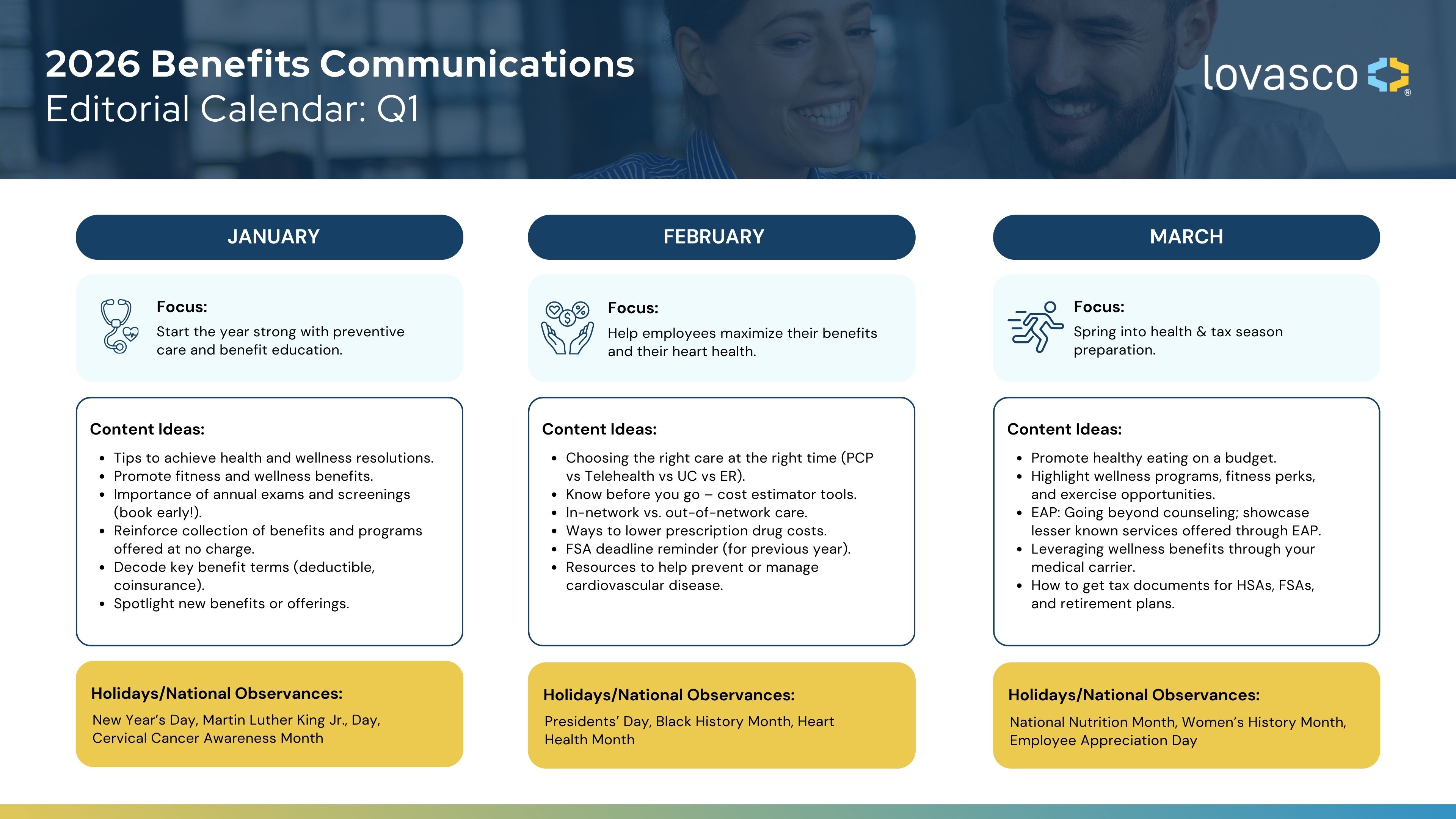
In our experience, the challenge usually isn’t a lack of commitment. It comes down to two very real inhibitors:
- Taking the time to plan the work, and
- Having the time to work the plan.
The First Blocker: Taking the Time to Plan the Work
Most HR leaders agree that communicating benefits only during annual enrollment isn’t enough. Yet without a roadmap, benefits communication tends to become reactive, driven by deadlines, vendor requests, fire drill assignments or compliance needs rather than employee readiness.
Planning the work means stepping back and asking more strategic questions:
- What are employees likely thinking about or dealing with at different times of the year?
- When are they most receptive to information about health, finances, family, or wellbeing
- Which benefits/topics can be introduced gradually through drip campaigns, instead of being crammed in during annual enrollment?
For example:
- Early in the year, employees may be focused on preventive care, wellness goals, or understanding how their deductible works.
- During tax season, HSAs, FSAs, and retirement contributions feel more relevant.
- In the fall, families are thinking about back-to-school routines, immunizations, and dependent benefits.
- Toward year-end, stress management, remaining FSA balances, and reflection take center stage.
A thoughtful editorial calendar aligns benefits education with these natural moments in time. Instead of asking employees to absorb everything at once (during a time-crunched annual enrollment season), communication becomes timely, relevant, and far more effective.
The Second Blocker: Having the Time to Work the Plan
Even with a solid plan in place, many HR teams hit a second—and often bigger—obstacle: bandwidth.
HR departments are balancing compliance, employee relations, vendor management, and daily problem-solving. Creating consistent, engaging benefits content often gets pushed aside, even when the intent is there.
This is where many well-designed plans quietly stall.
Relying solely on a passive benefits website doesn’t solve the problem. Employees aren’t browsing resource libraries in their free time. If information isn’t pushed to them—clearly, concisely, and at the right moment—it often goes unnoticed.
Working the plan requires time, focus, and communication expertise…resources many HR teams simply don’t have internally.
Why Year-Round Benefits Communication Is Worth the Effort
When organizations overcome these two barriers, the return is meaningful.
Year-round benefits communication helps employers:
- Increase Awareness and Utilization
Employees are more likely to use benefits they understand, especially programs that are fully subsidized and available throughout the year. Frequent communication ensures employees fully grasp the breadth of their benefits. When employees understand what’s available, they’re more likely to use those benefits, leading to increased satisfaction and a healthier workforce. - Improve the Employee Experience
Clear, timely communication builds trust and reinforces that the organization genuinely cares about employees’ total wellbeing. Regular updates create transparency and build trust, which boosts morale and fosters a culture of engagement. When employees feel valued and supported through continuous communication, they’re more likely to stay engaged and productive. - Adapt to Evolving Employee Needs
Employees' needs change over time—whether through life events, career milestones, or changing priorities. Year-round communication ensures that employees are always informed about what benefits are available to them at each stage, helping them feel supported during key transitions. Life events, career milestones, and personal priorities change…so should your company’s communications initiatives and strategies. - Simplify Annual Enrollment
When education happens throughout the year, annual enrollment can focus on decisions and deadlines—rather than information overload. This also makes enrollment less stressful and more manageable. When employees are well-informed, they can make confident elections during enrollment, reducing confusion and increasing overall satisfaction with their choices. - Support Retention and Recruitment
Employees can’t appreciate what they don’t understand. Well-communicated benefits become a visible and valued part of the employer value proposition. Consistent communication reinforces the value of your benefits, showing employees that their wellbeing is a priority. When employees recognize how total rewards align with their needs—such as health, financial security, and work-life balance—it strengthens both retention and recruitment efforts.
Need Help? It’s Just a Call Away!
At LoVasco, our Employee Communications team partners with HR leaders to address both sides of the challenge.
We help organizations plan the work by:
- Developing year-round communication strategies and editorial calendars
- Identifying relevant themes, timing, and channels
- Aligning benefits communication with employee needs and business objectives
- Consulting on best practices and proven methodologies other leading employers are implementing
And we help them work the plan by:
- Drafting and designing employee-ready content, relevant to each employer’s specific situation and audiences
- Translating complex benefits into clear, engaging messages, leveraging a range of media and formats (video, infographics, etc.)
- Providing execution support when internal bandwidth is limited
Our role isn’t to replace HR—it’s to support HR by taking the heavy lift off their plates, so proactive communication becomes sustainable rather than aspirational.
A Practical Place to Start
If you’re thinking about how to improve employee benefits communication in 2026, the first step doesn’t need to be complicated.
Download LoVasco Consulting Group’s complimentary 2026 Benefits Communications Editorial Calendar to start mapping out a year-round approach that keeps employees informed, engaged, and supported—without overwhelming your HR team .
When HR teams have both the time to plan the work and the support to work the plan, benefits communication stops being reactive…and starts delivering measurable ROI.

Is Your Retirement Plan Consultant Actually Doing Their Job?
Take the Self-Assessment to Find Out.
You're responsible for your company’s retirement plan. But with shifting regulations, mounting fiduciary risks, and growing employee expectations, how do you know if you have the right fiduciary oversight and financial wellness process in place?
It takes just 3 minutes
It’s completely free
Receive customized results instantly
Not sure where to start?
15 Questions to Score Your Organization's Benefit Program
See what you are missing.
Confirm where you shine.
Track progress over time.
Do your employees truly understand and value the generous benefits you offer?
Take the Employee Communications Assessment to Find Out.
Quickly benchmark your current employee communications efforts across clarity, education, employee engagement, and overall employee experience—so you can uncover gaps, identify opportunities, and build a happier, healthier workforce!
It takes just 2 minutes
It's completely free
Receive detailed Scorecard and customized assessment instantly

Subscribe to Our Insights Blog
Receive the latest articles from LoVasco's team of experienced experts on employee benefits and retirement plan best practices.

