

Why Changing Your Retirement Plan Consultant Feels Harder Than It Is


The Three Simple and Quick Steps Plan Sponsors Can Take to Improve their Retirement Plan Experience
Most plan sponsors don’t delay improving their retirement plan because they don’t care. In fact, it’s usually the opposite.
They know something isn’t quite right. Service feels reactive instead of proactive. Fiduciary responsibilities feel heavier each year. Employee engagement isn’t where it should be. And yet—despite good intentions—many organizations hesitate to take the next step.
The reason we hear most often isn’t cost. It’s effort.
There’s a common assumption that engaging a new retirement plan consultant will create a wave of administrative work, internal disruption, and employee confusion. So sponsors postpone action, telling themselves they’ll revisit the issue “after open enrollment,” “next quarter,” or “once things slow down.”
In reality, that perceived burden rarely matches what actually happens. There are, in fact, only three things needed to make this transition painless, seamless, and effortless:
- two signatures
- one meeting
The Assumption: A Heavy Administrative Lift
When plan sponsors think about making a change, they often picture a long list of to‑dos:
- rebuilding the plan from scratch
- coordinating multiple vendors
- re‑educating employees
- managing paperwork and compliance details internally
There’s also a related misconception that changing a consultant automatically means changing recordkeepers, payroll processes, or investment platforms—all at once.
That assumption alone can be enough to stall progress. While those larger projects can exist in certain situations, they are usually not part of the initial decision to engage a new retirement plan consultant. And that distinction matters.
The Reality: What Actually Happens When You Engage a New Consultant
At its core, onboarding a new retirement plan consultant is intentionally simple. To formally engage LoVasco, for example, there are typically just three required steps, all of which take little time or effort:
1. Advisor of Record (AOR) Form Signature
This document designates us as the plan’s retirement plan consultant with your existing recordkeeping and administrative provider. It allows us to access plan data, communicate directly with service providers, and manage the plan on your behalf.
2. Investment Advisory Agreement Signature
This agreement outlines the services we’ll provide, the fee structure, and the fiduciary framework governing the relationship.
Once those two documents are executed, the plan is officially onboarded. From there, we schedule a kickoff meeting.
3. The Strategic Kickoff Meeting
Our initial meeting with clients is not about adding work; it’s about assuring strategic and logistical alignment. We confirm your priorities, establish timelines, and clarify what we’ll handle versus where sponsor input is needed. In most cases, once the kickoff call is complete, the heavy lifting shifts almost entirely to our side.
What We Handle vs. What’s Required from the Plan Sponsor
One of the biggest sources of hesitation comes from uncertainty about “who does what.” For our part, we are able to deliver on a promise to take the burden off of the client and take responsibility for both the action plan and the outcome. It’s all part of what we proudly hail as our organization’s “Culture of Extreme Ownership.”
Here’s how that typically breaks down.
Handled by LoVasco:
- coordinating directly with recordkeepers and administrators
- gathering and analyzing plan data
- benchmarking fees and services
- reviewing investment menus
- managing fiduciary documentation and process
- drafting participant communications
- Rolling out employee education and financial wellness programs
- quarterbacking service issues and follow‑ups
Required from the Plan Sponsor:
- signing the initial engagement documents
- participating in the kickoff meeting
- providing feedback and approvals on recommendations
- making informed decisions as a fiduciary committee
That’s it. It really is that simple, as illustrated by our proven process to make our clients’ lives easier and their retirement plans more rewarding to sponsor, both for the employer and plan participants alike.
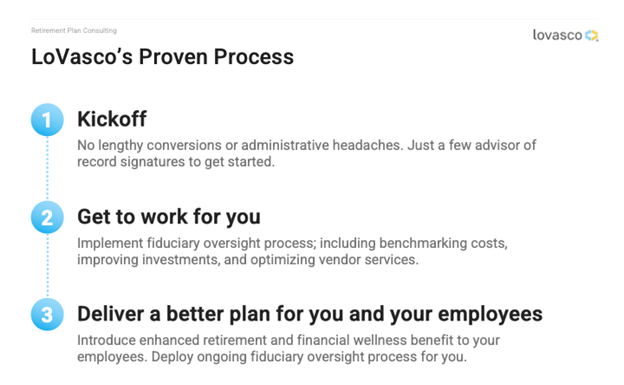
Sponsors remain decision‑makers, but they are no longer responsible for orchestrating the work behind the scenes. Our role is to remove that administrative weight—not add to it.
Why the Misconception Exists in the First Place
Much of the confusion stems from conflating two very different projects:
- changing your retirement plan consultant
- changing your recordkeeping and administrative provider
The latter can be a more involved process. When a plan sponsor decides to move to a new recordkeeper, that typically occurs only after careful evaluation. It’s a separate initiative, with its own timeline and level of sponsor involvement. But that project is not required to engage a new consultant.
In many cases, sponsors first bring us in specifically to improve outcomes on their existing platform, negotiating fees, addressing service gaps, and implementing better governance without disrupting what already works.
When those two ideas get lumped together, the perceived effort feels far larger than the reality.
What About Employees? Minimal Disruption, by Design
Another common concern is how a consultant change will affect participants. The short answer: it usually doesn’t.
Employees continue logging into the same recordkeeping system. Payroll contributions flow as they always have. Employees are not required to take any action if the investment lineup changes; any updates are handled automatically on their behalf.
As part of onboarding, we work with sponsors to determine the right communication approach, whether that’s an introduction meeting, a webinar, or written materials. In many cases, we draft those communications for the sponsor to review and distribute. Participants are informed, supported, and given access to education and guidance, but they are not burdened with action items simply because a consultant has changed.
Fast‑Forward 90 Days: What the Relationship Looks Like
Once onboarding is complete, the focus shifts quickly from transition to progress. Within the first few months, sponsors typically experience:
- a clear meeting cadence (quarterly or semi‑annual)
- a defined fiduciary framework, including documentation and governance support
- proactive investment and plan design reviews
- stronger employee engagement through education and financial wellness offerings
- fewer service issues landing on internal desks
Perhaps most importantly, sponsors gain greater confidence in their retirement plan process…and less day‑to‑day administrative burden managing it.
The Real Cost of Waiting
The organizations we see struggle most aren’t those with bad intentions. They’re those who delay action because they overestimate how hard it will be to get started.
Engaging a new retirement plan consultant is rarely the disruptive, resource‑heavy process it’s imagined to be. In most cases, it’s a straightforward transition that allows sponsors to focus on their business while experienced professionals handle the complexity behind the scenes.
If your plan isn’t delivering the outcomes you expect—for your committee or your employees—it may be worth revisiting the assumption that change has to be painful.
Often, the hardest part is simply deciding to decide.
Is Your Retirement Plan Consultant Actually Doing Their Job?
Take the Self-Assessment to Find Out.
You're responsible for your company’s retirement plan. But with shifting regulations, mounting fiduciary risks, and growing employee expectations, how do you know if you have the right fiduciary oversight and financial wellness process in place?
- It takes just 3 minutes.
- It's completely free.
- Receive customized results instantly.

Is Your Retirement Plan Consultant Actually Doing Their Job?
Take the Self-Assessment to Find Out.
You're responsible for your company’s retirement plan. But with shifting regulations, mounting fiduciary risks, and growing employee expectations, how do you know if you have the right fiduciary oversight and financial wellness process in place?
It takes just 3 minutes
It’s completely free
Receive customized results instantly
Not sure where to start?
15 Questions to Score Your Organization's Benefit Program
See what you are missing.
Confirm where you shine.
Track progress over time.
Do your employees truly understand and value the generous benefits you offer?
Take the Employee Communications Assessment to Find Out.
Quickly benchmark your current employee communications efforts across clarity, education, employee engagement, and overall employee experience—so you can uncover gaps, identify opportunities, and build a happier, healthier workforce!
It takes just 2 minutes
It's completely free
Receive detailed Scorecard and customized assessment instantly

Subscribe to Our Insights Blog
Receive the latest articles from LoVasco's team of experienced experts on employee benefits and retirement plan best practices.

