

Q2 → Q3 2026 Legislative Update: Long-Term Part-Time Rules, Trump Accounts, and a More Fiduciary-Friendly DOL

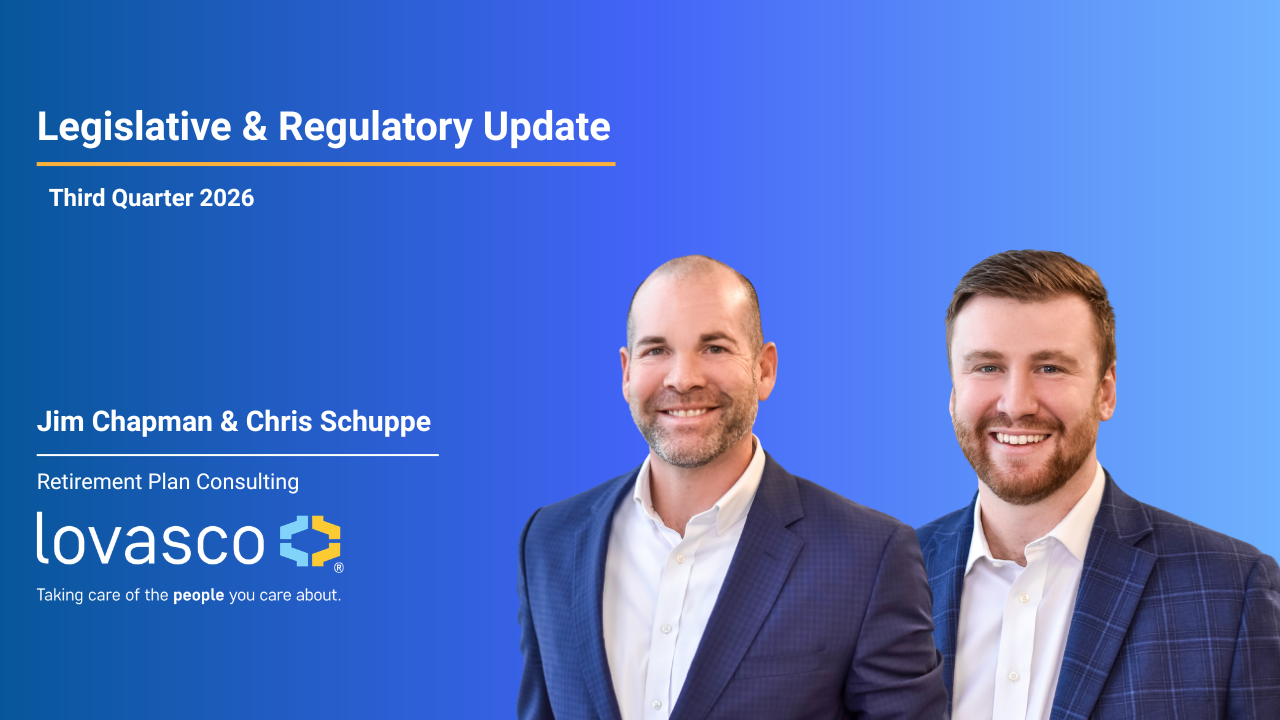
The rules governing retirement plans keep moving, and staying ahead of them is part of what fiduciary oversight actually means in practice. In our Q2 → Q3 2026 Legislative Update, Retirement Plan Consultants Jim Chapman and Chris Schuppe walk through the most important developments shaping employer-sponsored retirement plans right now.
If you're charged with overseeing a company retirement plan, this quarter's briefing covers four topics you need to understand:
- The long-term part-time employee rule: why this year is the first real test, and what your amendment deadline looks like
- A second delay of final RMD regulations: what's postponed, what isn't, and why good-faith compliance still matters
- Trump Accounts: new DOL guidance removes a major ERISA barrier for employers
- ERISA litigation: a notably friendlier posture from the DOL, and what it does (and doesn't) change for fiduciaries
Highlights and Takeaways
► The Long-Term Part-Time Employee Rule Is No Longer Theoretical
SECURE 2.0 requires 401(k) plans that exclude part-time employees to allow long-term part-time (LTPT) workers to contribute once they've logged 500+ hours of service in two consecutive years. That rule has been on the books since 2022, but this year marks the first real test of it — the two-year lookback has finally run its course, meaning employees are becoming eligible now.
Three things plan sponsors need to have in place:
- Tracking systems. Many payroll and HR platforms weren't built to track hours across multiple plan years. If your recordkeeper or TPA is handling this, confirm exactly how — and if they aren't, build an internal audit process so no one falls through the cracks. Missed eligibility can mean penalties, lost earnings, and missed deferral opportunities.
- Classification risk. Part-time status alone doesn't allow exclusion once an employee meets the LTPT threshold. Other exclusions — collectively bargained employees, leased employees, non-resident aliens — still apply, but if your plan document only excludes "part-time," it's worth revisiting your employee groups and plan design.
- Amendment deadline. Plans must be operationally compliant now, but formally amended by December 31, 2026 to incorporate the LTPT rule along with the other mandatory SECURE 2.0 provisions.
Bottom line: If you haven't confirmed how your recordkeeper is tracking LTPT eligibility, this should be on the agenda at your next plan review — LoVasco is already working through provider-by-provider action items with clients this quarter.
► RMD Regulations Delayed Again — But Good-Faith Compliance Still Applies
In February, the IRS delayed the final required minimum distribution (RMD) regulations for the second time. The delayed provisions won't take effect until six months after final regulations are published — likely sometime in 2027 — but plan sponsors are still expected to operate under good-faith compliance in the meantime.
What's actually been delayed:
- Surviving spouse elections, which allow a spouse to be treated as the participant for RMD purposes in a defined contribution plan
- Final clarification on the Roth account RMD exemption established under SECURE 2.0
- Treatment of partial annuity elections, including an increase to the qualifying dollar threshold to $210,000 in 2026
What hasn't been delayed — and still applies:
- Age 73 remains the RMD starting age
- The 10-year distribution rule for most inherited accounts
- Elimination of pre-death RMDs for designated Roth 401(k) accounts
Bottom line: Use this delay as an opportunity to evaluate your recordkeeping system's handling of the Roth RMD elimination and surviving spouse rules now, rather than waiting for final regulations to force the issue.
► Trump Accounts: DOL Removes a Major Barrier for Employers
Trump Accounts — the tax-advantaged accounts for children under 18 created by the 2025 Big Beautiful Bill — allow employer contributions of up to $2,500. Until recently, it was unclear what fiduciary responsibility or liability employers would take on by contributing. On June 17, the DOL issued guidance clarifying that employer contributions to Trump Accounts are not ERISA-covered — removing a major barrier to entry for plan sponsors.
A few important caveats:
- This is informal guidance, not a blanket ERISA exemption. Tax reporting and operational guidance from the IRS are still pending.
- Employers should not endorse the program or represent it as a company-sponsored benefit. Permissible activities include posting neutral information on a company intranet, sharing payroll deduction details, and linking to trumpaccount.org.
- As long as employers aren't influencing investment decisions, this remains a voluntary, non-ERISA benefit for participants.
Bottom line: There's now a clearer safe-harbor framework for employers considering Trump Account contributions, but full operational clarity from Treasury and the IRS is still ahead. Expect more guidance in the coming weeks or months.
► ERISA Litigation: A Notably Friendlier Posture from the DOL
Under new EBSA head Daniel Aronowitz, the Department of Labor has begun shifting away from what he's called "regulation by opportunistic litigation." That shift is already showing up across several active cases:
- Excessive fees — In Pizarro v. Home Depot, the DOL reversed course, arguing it's the plaintiffs' burden to prove fiduciaries mismanaged fees, not the plan sponsor's burden to prove they didn't.
- Investment benchmarking — In Johnson v. Parker-Hannifin, which alleged a fiduciary breach for retaining higher-cost fund share classes without adequate monitoring, the DOL has asked the Supreme Court to take a closer look, moving the issue out of the lower courts.
- Pension risk transfers — In Konya v. Lockheed Martin, the DOL argued that the decision to execute a pension risk transfer is a settlor (business) function, not a fiduciary one — a meaningful distinction that reframes how these transactions are evaluated.
- Forfeitures — The DOL filed amicus briefs supporting dismissal in four cases alleging that using forfeiture dollars to offset future employer contributions breaches fiduciary duty. With roughly 60 active forfeiture cases still in the courts, the DOL's position reaffirms that reducing future employer contributions has always been an acceptable practice under ERISA.
- One to watch — Anderson v. Intel, involving an investment committee decision, is still developing. We'll report on it in future quarters.
Bottom line: An easing DOL posture is good news, but it doesn't change the fiduciary governance process. Maintain rigorous investment oversight, document every decision, and monitor and benchmark investments, fees, and recordkeepers on a regular, scheduled basis — that discipline is what actually protects fiduciaries, regardless of which way the regulatory winds are blowing.
What This Means for Plan Sponsors and Fiduciaries
With several moving pieces converging at once, this is a good quarter to get ahead rather than react. Sponsors should:
- Confirm with your recordkeeper or TPA exactly how long-term part-time eligibility is being tracked, and build an internal audit process if it isn't sufficient
- Plan for a formal document amendment incorporating the LTPT rule and other mandatory SECURE 2.0 provisions by December 31, 2026
- Review recordkeeping system readiness for the Roth RMD exemption and surviving spouse election rules, even while final regulations remain pending
- If considering Trump Account contributions, work with counsel to structure communications so they inform without endorsing
- Keep documentation of investment oversight, fee benchmarking, and recordkeeper monitoring current — regardless of the more favorable litigation environment
Staying proactive — not reactive — remains the best way to protect plan fiduciaries and participants alike as these rules continue to evolve.
Have questions about any of these updates and how they apply to your plan? Reach out to the LoVasco team — we're happy to discuss.

Is Your Retirement Plan Consultant Actually Doing Their Job?
Take the Self-Assessment to Find Out.
You're responsible for your company’s retirement plan. But with shifting regulations, mounting fiduciary risks, and growing employee expectations, how do you know if you have the right fiduciary oversight and financial wellness process in place?
It takes just 3 minutes
It’s completely free
Receive customized results instantly
Not sure where to start?
15 Questions to Score Your Organization's Benefit Program
See what you are missing.
Confirm where you shine.
Track progress over time.
Do your employees truly understand and value the generous benefits you offer?
Take the Employee Communications Assessment to Find Out.
Quickly benchmark your current employee communications efforts across clarity, education, employee engagement, and overall employee experience—so you can uncover gaps, identify opportunities, and build a happier, healthier workforce!
It takes just 2 minutes
It's completely free
Receive detailed Scorecard and customized assessment instantly

Subscribe to Our Insights Blog
Receive the latest articles from LoVasco's team of experienced experts on employee benefits and retirement plan best practices.

