

Q2 → Q3 2026 Capital Markets Update: Markets Normalize, Valuations Stay Elevated, and the Fed Faces a New Test

After three straight years of outsized equity gains, 2026 has delivered something investors haven't seen in a while: a market that looks and feels normal. Returns have cooled from the 20%-plus years of 2023-2025, leadership is starting to broaden beyond the mega-cap tech names, and the Federal Reserve — under new Chair Kevin Warsh — is wrestling with inflation that has crept back above 4%.
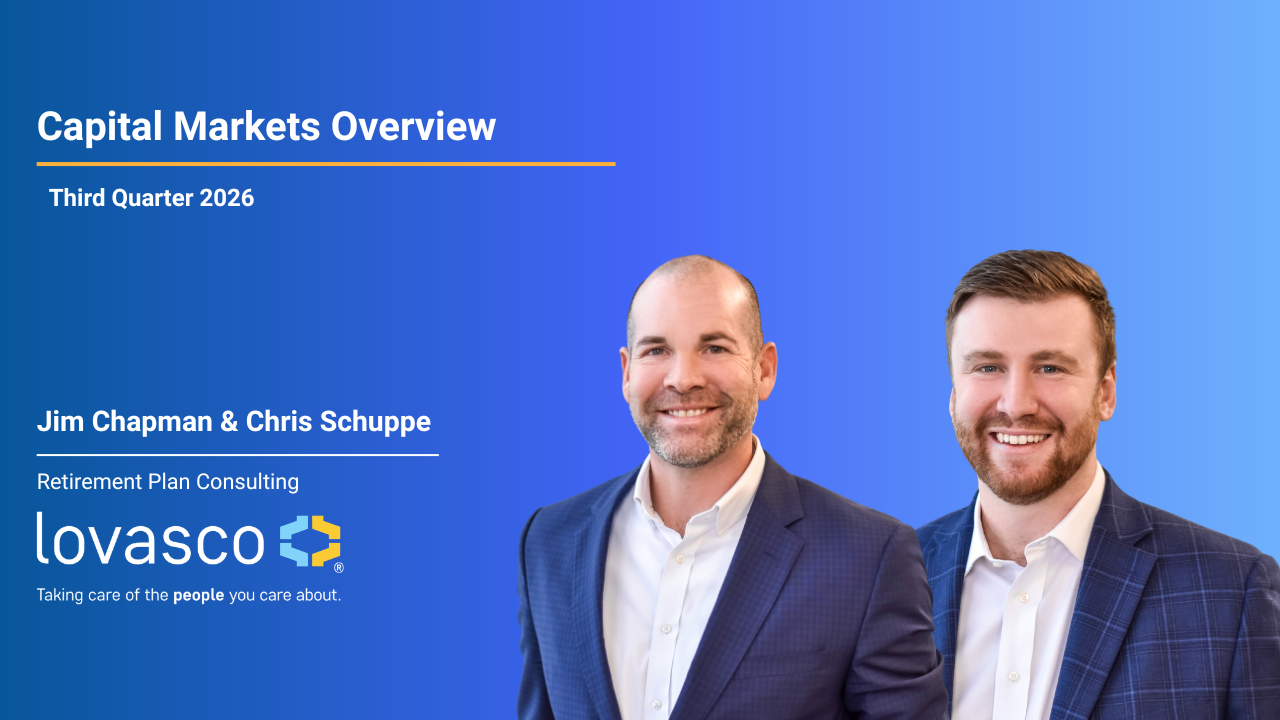
In LoVasco's latest Capital Markets Review, Retirement Plan Consultants Jim Chapman and Chris Schuppe break down what happened in the second quarter of 2026, what's shaping the third quarter, and what plan sponsors and fiduciaries should be watching heading into the back half of the year.
If you sponsor a retirement plan, oversee pension assets, or serve on an investment committee, this quarterly update provides timely context for evaluating portfolio strategy and participant outcomes.
Highlights and Takeaways
► Returns are moderating toward historical norms — and that's a good thing
The S&P 500 is up approximately 10% year-to-date through June 30, 2026, following gains of 24% in 2023, 23% in 2024, and 18% in 2025. That three-year run wasn't sustainable, and a return closer to the market's long-term average is a healthy sign, not a warning sign — even if some investors are second-guessing a "slow" year that's actually right on trend.
► Leadership is shifting away from the Magnificent Seven, and value is making a push
For the past several years, returns have been dominated by the Magnificent Seven — Nvidia, Apple, Microsoft, and their peers. That's starting to change. Through June 30, the Mag Seven are roughly flat on the year, while the rest of the S&P 500 is up about 15%. Large-cap value is outperforming large-cap growth (16.3% vs. 5.3%), and for the first time in quite a while, active managers in large-cap growth are outperforming their benchmark — a direct byproduct of not having 30-40% of a portfolio concentrated in a handful of stocks.
► Valuations remain elevated across the board
Every major valuation measure the team tracks — including the CAPE ratio (cyclically adjusted price-to-earnings) — is sitting at elevated levels. Forward P/E has again pushed above the 20.5x mark, a threshold that has historically preceded corrections (the dot-com bubble, the post-COVID pullback, early 2025). Historically, high valuations like these tend to point toward more muted returns over the following decade. That said, elevated valuations alone rarely trigger a downturn — it usually takes a shock, such as a hit to earnings or an escalation in the Middle East conflict, to turn the market. Encouragingly, earnings season has been strong so far, particularly in AI-related names, which could help valuations compress in a healthy way rather than through a price correction.
► Concentration in the S&P 500 is at levels not seen before
The top 10 stocks in the S&P 500 now make up nearly 40% of the entire index — a level of concentration that creates real diversification challenges for retirement plan portfolios. When those names are running hot, passive index exposure looks unbeatable. But that same concentration means a stumble in just a few stocks could have an outsized impact on the broader market — one reason the team continues to emphasize genuine diversification over chasing recent performance.
► Inflation is back in the conversation, and the Fed's posture has shifted
Inflation has climbed back above 4%, well above the Fed's 2% target, and the Fed has already made one rate hike this year. New Fed Chair Kevin Warsh has been clear that the Fed has "zero tolerance" for inflation running out of control. That's a meaningful shift from expectations at the start of the year, when many anticipated 2026 would mirror 2024 and 2025 — a neutral stance for most of the year followed by cuts in Q4. Instead, the Fed may need to raise rates further before it can cut. The next Fed meeting is July 27-28, with the fed funds rate currently sitting at 3.5%-3.75%.
► Fixed income finally offers a more normal opportunity set
After four years of an inverted yield curve, the curve is finally beginning to normalize. That matters for retirement plans: for the first time in a while, money market funds have out-yielded stable value options, though that dynamic could shift again if rates rise further. Longer-duration bonds remain more interest-rate sensitive, while shorter and intermediate durations are likely to stay more stable through the rest of 2026. With rates fluctuating, this is an environment where skilled active bond managers can add real value — a key reason the team continues to evaluate the philosophy and makeup of the active managers used in core fund lineups.
► International and emerging markets are outperforming — but concentration risk is showing up there too
A weaker dollar and more attractive relative valuations have fueled strong performance abroad. Non-U.S. developed markets are up about 14% year-to-date, and emerging markets are up nearly 25%, led by Asian semiconductor names. But that strength comes with its own concentration story: just three companies — Samsung, SK Hynix, and Alibaba — make up roughly 35% of the emerging markets index, and the top 10 stocks account for 41% of the entire benchmark. As with U.S. large-cap growth, that concentration has made it hard for active managers to keep pace during the run-up — but it also means active management could offer meaningful downside protection if any of those top names stumble.
What This Means for Plan Sponsors and Fiduciaries
With valuations elevated, market leadership shifting, and the Fed's path less certain than it looked six months ago, discipline matters more than ever. Sponsors should:
- Revisit investment menu diversification in light of record concentration in both U.S. and emerging market indexes
- Evaluate the case for active management in large-cap growth and emerging markets, where recent underperformance has coincided with historic index concentration
- Review fixed-income lineups as the yield curve normalizes and rate expectations shift
- Keep an eye on how sustained inflation and a more hawkish Fed posture could affect participant behavior and plan design
Staying proactive — not reactive — remains the best way to support long-term participant outcomes, especially as the market moves from an extraordinary three-year stretch back toward something more historically normal.
Have questions about how these trends could affect your plan's investment lineup or fiduciary process? Reach out to the LoVasco team — we're happy to discuss.

Is Your Retirement Plan Consultant Actually Doing Their Job?
Take the Self-Assessment to Find Out.
You're responsible for your company’s retirement plan. But with shifting regulations, mounting fiduciary risks, and growing employee expectations, how do you know if you have the right fiduciary oversight and financial wellness process in place?
It takes just 3 minutes
It’s completely free
Receive customized results instantly
Not sure where to start?
15 Questions to Score Your Organization's Benefit Program
See what you are missing.
Confirm where you shine.
Track progress over time.
Do your employees truly understand and value the generous benefits you offer?
Take the Employee Communications Assessment to Find Out.
Quickly benchmark your current employee communications efforts across clarity, education, employee engagement, and overall employee experience—so you can uncover gaps, identify opportunities, and build a happier, healthier workforce!
It takes just 2 minutes
It's completely free
Receive detailed Scorecard and customized assessment instantly

Subscribe to Our Insights Blog
Receive the latest articles from LoVasco's team of experienced experts on employee benefits and retirement plan best practices.

