

Q2 2026 Legislative Update: Guaranteed Income, Private Equity, and a $43 Million Forfeiture Settlement

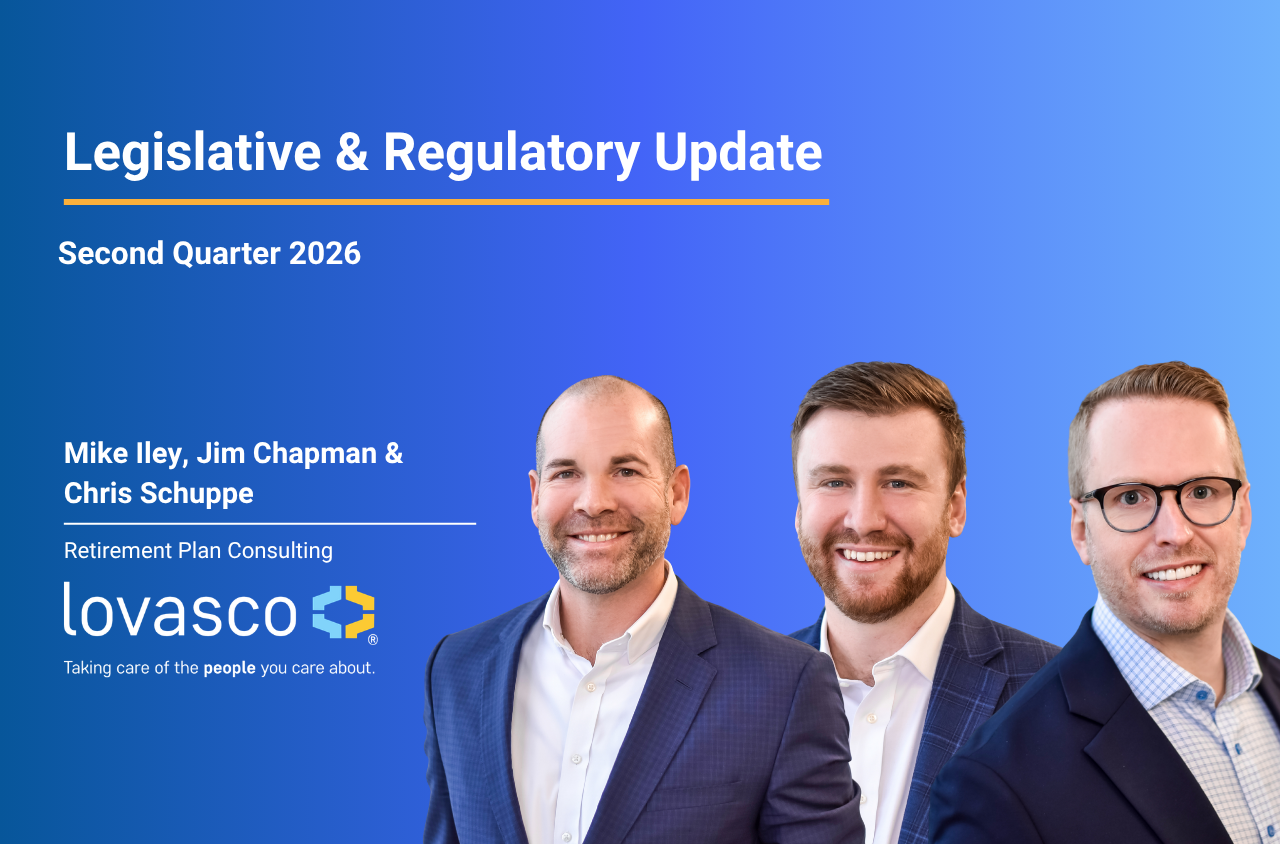
The rules governing retirement plans keep moving, and staying ahead of them is part of what fiduciary oversight actually means in practice. In our Q2 2026 Legislative Update, Retirement Plan Consultants Jim Chapman and Chris Schuppe joined host Mike Iley to walk through the most important developments shaping employer-sponsored retirement plans right now.
If you’re charged with overseeing a company retirement plan, this quarter’s briefing covers three topics you need to understand:
- SECURE 2.0’s guaranteed income provisions: what they allow, what they require, and whether they’re right for your plan
- The DOL’s proposed rule on private equity in 401(k) plans: why it matters and what fiduciaries should be watching for
- A $43 million forfeiture lawsuit, and what it reveals about the importance of plan document sequencing
Highlights and Takeaways
► SECURE 2.0 Opens the Door to Guaranteed Income, But It Doesn’t Lower the Fiduciary Bar
SECURE Act 1.0 introduced safe harbors for adding guaranteed income options to 401(k) plans. SECURE 2.0 built on that foundation, and while it grants plan sponsors the option to include annuities, it does not reduce the oversight burden. If anything, it raises it.
Here’s what plan sponsors need to understand:
- Guaranteed income can come in three forms: plan-level annuitization of accumulated balances, hybrid target date funds with built-in annuity features, and out-of-plan distribution options that allow participants to purchase an annuity at retirement.
- The safe harbor requires a prudent, documented process—the same fiduciary standard that governs all plan decisions, now extended to the evaluation of insurance carriers, their financial strength, and their claims-paying ability.
- Once a participant annuitizes a portion of their balance, that decision is largely irreversible. Liquidity constraints and product complexity make participant education essential…not optional.
- Cost is a real factor. The economics of annuities mean the insurance company is managing your participants’ money for a return. That’s not inherently wrong, but it demands scrutiny.
Jim Chapman offered a candid perspective: for participants who want the behavioral security of a guaranteed paycheck—or those who may struggle to self-manage a lump sum in retirement—annuities can be a meaningful option. But transparency about how they work, what they cost, and what they give up is non-negotiable before any plan adds them.
Bottom line: Before adding guaranteed income options, assess your participant demographics, your team’s capacity to take on enhanced fiduciary oversight, and your ability to communicate clearly about a complex product. The safe harbor is a guardrail, not a green light.
► The DOL’s Proposed Rule on Private Equity: What’s Actually on the Table
The Department of Labor has signaled, through a proposed rule open for comment through June 1st, that private equity and alternative investments may have a place in 401(k) plans. This is consistent with the direction set in 2025, when the DOL rescinded prior language discouraging alternatives and placed the decision squarely in fiduciaries’ hands.
The proposed rule introduces a six-factor framework for evaluating private equity as part of a plan’s investment lineup. These factors will be familiar to anyone already running a disciplined fiduciary process:
- Performance: Consistent with standard investment oversight, rack record matters.
- Fees: Fee transparency in private equity is an ongoing concern. As products evolve for the 401(k) market, this will be scrutinized closely.
- Liquidity: Traditional private equity positions can’t be entered and exited freely. Product structures designed for 401(k) use are working to solve this, but it remains a real consideration for participant access.
- Valuation: Unlike mutual funds with daily NAV, private equity valuations aren’t always marked to market. How record keepers will handle this on a daily basis is still an open question.
- Benchmarking complexity: These investments don’t fit neatly into traditional benchmark frameworks. Investment policy statements will need to evolve.
- Participant impact: How much is an appropriate allocation? That guidance is still forthcoming.
Jim Chapman offered an honest read: he’s genuinely excited about broader access to an asset class that’s long been reserved for high-net-worth investors. But he’s also clear-eyed that the same things that made Roth catch-up implementation slow and complicated are likely to apply here. There will be a gap between policy direction and operational clarity for plan sponsors and record keepers.
Bottom line: Watch the comment period. Final regulation is likely; momentum is too strong for this to stall. When it arrives, the plans best positioned will be those that already have rigorous fiduciary processes in place. Participant education will be critical from day one.
► Forfeiture Litigation Is Still Active. This Case Shows Why the Details Matter.
If forfeiture lawsuits feel like old news, the settlement in Halter v. Providence Health is a reminder that they’re still very much alive…and that the risks aren’t always where you expect them.
In this case, Providence Health used forfeiture funds to offset future employer contributions—a use explicitly permitted by their own plan document. The challenge wasn’t whether the use was permissible. It was about sequencing.
The plaintiffs argued that because offsetting employer contributions was listed last among the permissible uses, Providence should have exhausted the other options first. The case settled for $43 million.
What every plan sponsor should take away:
- Confirm your plan document explicitly allows all three standard uses of forfeitures: paying plan expenses, restoring participant accounts (e.g., for a QNEC), and offsetting future employer contributions.
- Review the sequencing language carefully. If your document lists these uses in a specific order, your operations need to reflect that order — or you need language that makes clear no hierarchy is implied.
- Operational compliance is not just about doing the right things. It’s about doing them in the order your document specifies.
As Chris Schuppe noted, this is the kind of exposure that a strong fiduciary oversight process is designed to catch before it becomes a liability. The law firms bringing these cases are looking for gaps — and a $43 million settlement tells them the search is worth it.
Bottom line: Pull your plan document. Review your forfeiture section. If you’re not certain the language is tight, the next restatement or operational audit is the right time to address it.
Have questions about any of these updates and how they apply to your plan? Reach out to the LoVasco retirement team. We’ll help you think through what they mean for your specific situation.

Is Your Retirement Plan Consultant Actually Doing Their Job?
Take the Self-Assessment to Find Out.
You're responsible for your company’s retirement plan. But with shifting regulations, mounting fiduciary risks, and growing employee expectations, how do you know if you have the right fiduciary oversight and financial wellness process in place?
It takes just 3 minutes
It’s completely free
Receive customized results instantly
Not sure where to start?
15 Questions to Score Your Organization's Benefit Program
See what you are missing.
Confirm where you shine.
Track progress over time.
Do your employees truly understand and value the generous benefits you offer?
Take the Employee Communications Assessment to Find Out.
Quickly benchmark your current employee communications efforts across clarity, education, employee engagement, and overall employee experience—so you can uncover gaps, identify opportunities, and build a happier, healthier workforce!
It takes just 2 minutes
It's completely free
Receive detailed Scorecard and customized assessment instantly

Subscribe to Our Insights Blog
Receive the latest articles from LoVasco's team of experienced experts on employee benefits and retirement plan best practices.

