

Q2 2026 Capital Market Update: Volatility, Valuations, and What’s Driving the Shift

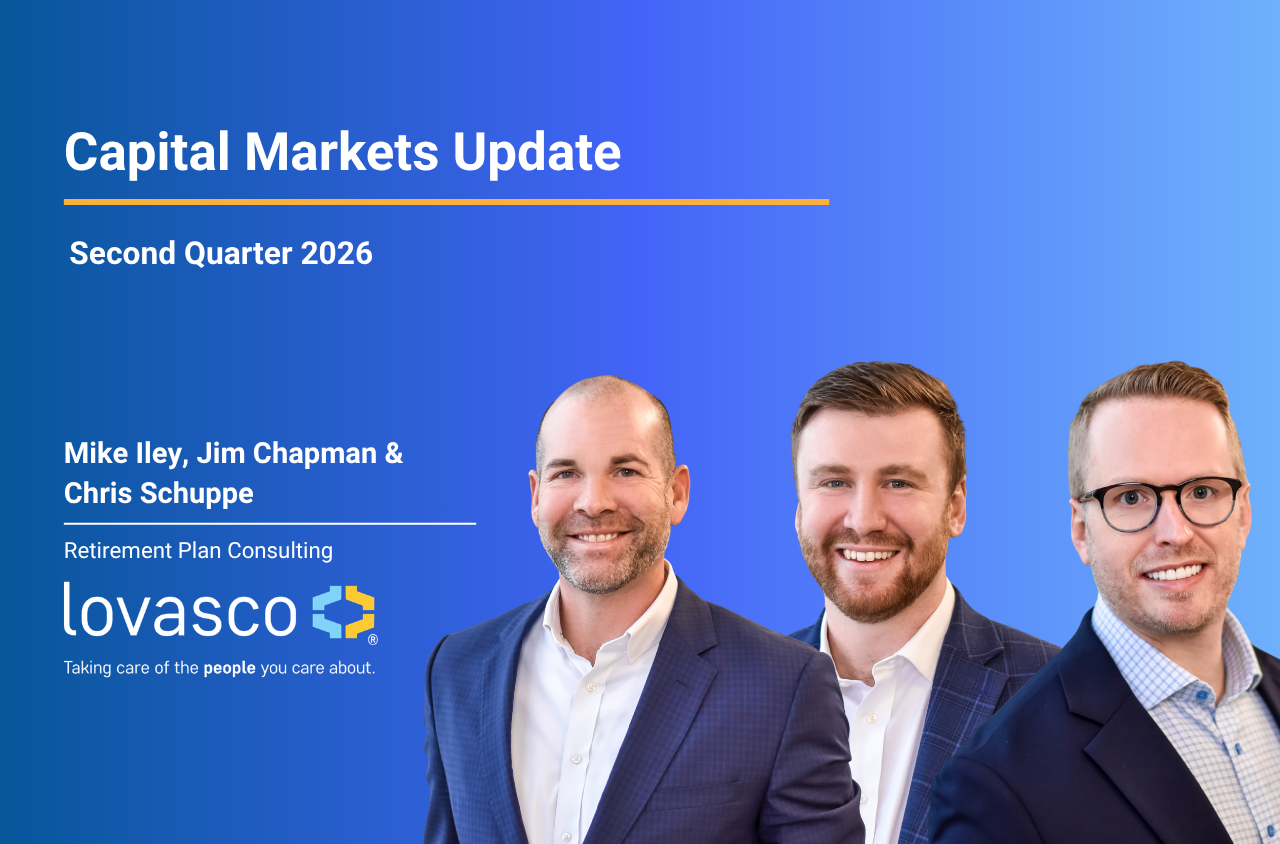
Markets have been unsettled to start 2026, and the reasons are layered. In our Q2 2026 Capital Market Update, Retirement Plan Consultants Jim Chapman and Chris Schuppe joined host Mike Iley to walk through what’s driving current market conditions, where different asset classes stand, and what long-term investors should keep in mind as the year unfolds.
This quarter’s briefing covers:
- The S&P 500, current valuations, and the factors creating uncertainty
- The Magnificent Seven and the growth-to-value rotation underway
- Sector performance and what the index composition is actually telling us
- Labor markets, the US dollar, oil, and international markets
- Gold’s recent performance and its role in a diversified portfolio
Highlights and Takeaways
► A Volatile Start to 2026: What’s Behind the Uncertainty
The S&P 500 is down roughly 1% year to date at the time of this recording, but that headline number understates how much is moving beneath the surface. Several forces are converging at once, and no single factor fully explains the current environment.
Geopolitical risk is the most visible driver. The conflict involving Iran has raised concerns about oil prices staying elevated, which in turn raises questions about inflation. That’s significant because inflation was the central force behind the market’s sharp 2022 decline, and the echoes of that period are not lost on investors.
At the same time, interest rate expectations have shifted. Coming into 2026, many expected the Federal Reserve to continue the rate-cutting path it began in 2025. That expectation has been revised. With inflation concerns reemerging and a softening labor market, the Fed is being cautious. Rates may stay higher for longer, and that recalibration is filtering through to equity valuations, borrowing costs, and investor sentiment.
Valuations are the third piece. As Chris Schuppe noted, S&P 500 valuations haven’t been at these levels since the dot-com era. Price-to-earnings (PE) ratios are elevated, the Shiller CAPE index is high, and dividend yields are near historic lows. None of these are precise timing signals, but taken together they suggest the market has been pricing in a lot of optimism. When that optimism meets uncertainty, volatility tends to follow.
Earnings season will be one of the more telling near-term tests. The first quarter of 2026 marks the sixth consecutive quarter of double-digit earnings growth. Whether that pace can continue, and whether AI and tech companies can demonstrate meaningful monetization, will shape how markets move through the summer.
► The Magnificent Seven and the Growth-to-Value Rotation
Few market dynamics have defined the last several years more than the Magnificent Seven—the large-cap tech and AI names that have driven outsized returns since 2021. In 2023 they were up 76%. In 2024, up 48%. In 2025, up 23%. That run has been extraordinary by any measure, and it has been a primary contributor to the elevated valuations the broader market now carries.
Year to date in 2026, the picture has shifted. The Magnificent Seven are down approximately 11%. The rest of the market is down only about 1%. That gap is notable: it suggests the current pullback is concentrated, not broad, and that the index’s heavy weighting toward these names is amplifying the headline decline.
A meaningful rotation from growth to value is underway. Year to date, large-cap growth is down approximately 10%, while value is up about 2.1%. That kind of reversal hasn’t been seen in some time. Several conditions are working in value’s favor right now: geopolitical uncertainty, elevated interest rates, and valuation concerns all tend to push investors toward companies with stronger balance sheets, steadier earnings, and consistent dividends. Mid-cap and small-cap value also appear attractive in this environment, given where relative valuations stand.
For active managers, the current environment may create more opportunity than recent years. When valuations are stretched and returns are concentrated in a handful of names, it is difficult to outperform without simply following the index. A broader market, with more differentiation across sectors and styles, gives active management more room to work.
► What the Sector Breakdown Is Actually Telling Us
The S&P 500’s overall performance masks a more uneven picture, when you look at sectors individually. Technology currently represents 33% of the index—roughly one third—a concentration that may not have a modern precedent, including the dot-com era. When tech is down 9.1% year to date, as it is now, that weighting pulls the entire index down considerably, regardless of what other sectors are doing.
The top five sector weights currently are:
- Technology: 33% of the index, down 9.1% year to date
- Financials: ~13%, down approximately 9% year to date
- Consumer Discretionary: ~10%, also down roughly 9% year to date
- Healthcare: ~9.5%
- Industrials: ~9%
Combined, the three largest sectors account for nearly half the index, and all three are down around 10% year to date. Meanwhile, some of the smaller, more value-oriented sectors are performing well. Energy is up 38.2%, driven by Middle East tensions. Consumer staples are up 7.7%. These sectors represent a much smaller share of the index—energy at roughly 4%, consumer staples at just over 5%—so their gains do little to offset the drag from the top three.
For investors who hold broadly diversified portfolios or use active management with sector balance, the current environment looks different than it does for those concentrated in index-matching exposures. Diversification, which has been a harder sell during years of tech-led growth, is doing exactly what it is designed to do.
► Labor Markets, the Fed, and the U.S. Dollar
The labor market has been weakening gradually since 2021. Many major employers have settled into a no-hire, no-fire posture. Non-farm payrolls came in at 92,000 in February—a significant decline—before bouncing back to 178,000 in March. That bounce may be an anomaly rather than a trend reversal.
As payroll growth slows, the next stage of the cycle typically brings rising unemployment and, eventually, wage deceleration. That trajectory matters to the Federal Reserve on two fronts. Wage deceleration would ease inflationary pressure. But rising unemployment would activate the Fed’s full employment mandate, pushing it toward more aggressive rate cuts. The 30-year average unemployment rate sits around 5.5%; how quickly the current rate approaches or exceeds that level will influence the pace of any Fed action.
The U.S. dollar strengthened modestly through Q1 after a period of weakness. Three factors are supporting it: trade is normalizing after the tariff disruptions of 2025, rate expectations have shifted toward higher-for-longer (which tends to support currency strength), and the dollar continues to function as a safe-haven asset during periods of global uncertainty. The dollar’s trajectory matters for international investments. Currency translation has been a meaningful contributor to international fund returns over the past year or so, and that tailwind has moderated somewhat as the dollar firms up.
► Oil, International Markets, and the Case for Diversification
Oil markets are being shaped by familiar forces: supply constraints from OPEC and Russia, steady US production growth driven by shale flexibility, and rising demand from China and India. The concerning dynamic is that oil inventories have been drawn down significantly since 2022, leaving limited buffer if a supply shock occurs. Prices could move quickly if the Middle East conflict escalates in ways that affect production or transit.
International markets had a strong 2025. The Eurozone was up 41.3% when accounting for currency exchange effects. Some of that tailwind has moderated as the U.S. dollar has strengthened. Year to date in 2026, international markets have experienced some of the same volatility as the U.S..
Valuations, however, tell a different story. Domestic PE ratios are running near 20x against a 20-year average closer to 16.5-17x. Major international indices—Europe, Japan, China, emerging markets—are trading much closer to their historical averages. From a pure valuation standpoint, international markets offer a deeper value opportunity relative to the U.S. right now.
This is a point worth sitting with for plan sponsors building target date models or overseeing diversified investment menus. International allocations have been an easy recommendation to second-guess during years of US large-cap dominance. The last 12-18 months have provided a reminder of why uncorrelated exposure matters. Diversification is designed for exactly the conditions the market is currently navigating.
► Gold: A Meaningful Hedge, Not a Portfolio Strategy
Gold has performed exceptionally well over the last year and a half. In environments characterized by dollar weakness, inflation concerns, and geopolitical risk (all of which have been present) gold tends to do what it is designed to do. Some individual funds with meaningful gold exposure have posted returns exceeding 100% over a one-year period.
Over longer horizons, gold has averaged roughly 6.7% annually…not far off long-term equity market averages of around 8%. That return profile, combined with its low correlation to equities, makes it a reasonable component of a diversified portfolio in the right sizing.
The caution worth noting: gold’s recent performance can make it look like the obvious answer to current market conditions. But timing any asset class is difficult, and a portfolio concentrated in gold is exposed to a sharp reversal if the conditions driving its current strength shift, such as dollar weakness, inflation fear, geopolitical tension, etc. A measured allocation as part of a broader, diversified portfolio is a different proposition than moving heavily into gold in response to near-term conditions.
► Staying the Course: The Case Against Market Timing
One theme ran through the entire conversation: the risk of allowing short-term volatility to drive long-term investment decisions.
Over the past 35 years, the S&P 500 has experienced an average intra-year decline of approximately 14%. In most of those years, the index still finished positive. The last three years are instructive. In 2023, the market finished up 24%. In 2024, up 23%. In 2025, up 18%. Each of those years included a significant intra-year drawdown. In 2025, the market fell nearly 19% at one point before recovering to finish up 18%.
For retirement plan participants, this history matters. The emotional pull to exit positions when markets decline is understandable. It is also one of the most reliable ways to miss the recovery. For plan sponsors, this reinforces the value of participant education frameworks that provide context during volatile periods—not to predict outcomes, but to help participants understand what normal market behavior looks like and why long-term discipline tends to serve investors better than reactive decision-making.
Have questions about how current market conditions affect your plan or investment menu? Reach out to the LoVasco retirement team. We’ll help you think through what it all means for your specific situation.

Is Your Retirement Plan Consultant Actually Doing Their Job?
Take the Self-Assessment to Find Out.
You're responsible for your company’s retirement plan. But with shifting regulations, mounting fiduciary risks, and growing employee expectations, how do you know if you have the right fiduciary oversight and financial wellness process in place?
It takes just 3 minutes
It’s completely free
Receive customized results instantly
Not sure where to start?
15 Questions to Score Your Organization's Benefit Program
See what you are missing.
Confirm where you shine.
Track progress over time.
Do your employees truly understand and value the generous benefits you offer?
Take the Employee Communications Assessment to Find Out.
Quickly benchmark your current employee communications efforts across clarity, education, employee engagement, and overall employee experience—so you can uncover gaps, identify opportunities, and build a happier, healthier workforce!
It takes just 2 minutes
It's completely free
Receive detailed Scorecard and customized assessment instantly

Subscribe to Our Insights Blog
Receive the latest articles from LoVasco's team of experienced experts on employee benefits and retirement plan best practices.

